
Landing Page Designer: The Ultimate Guide to High-Converting Pages
Ever clicked on a website and instantly knew whether you’d stay or leave? That’s the power of a landing page. And behind every high-converting page, there’s a skilled landing page designer making magic happen.Let’s break it all down in a way that actually makes sense—and maybe even inspires you to create your own high-performing pages.
What is a Landing Page Designer?
A landing page designer creates pages focused on one goal—conversion. Unlike regular websites, these pages eliminate distractions and guide users toward a single action like signing up or buying.
Definition and Role
A landing page designer is someone who creates web pages specifically built to convert visitors into leads or customers. Unlike regular web pages, landing pages have one goal—conversion.
Think of it like a digital salesperson that works 24/7 without asking for a salary.
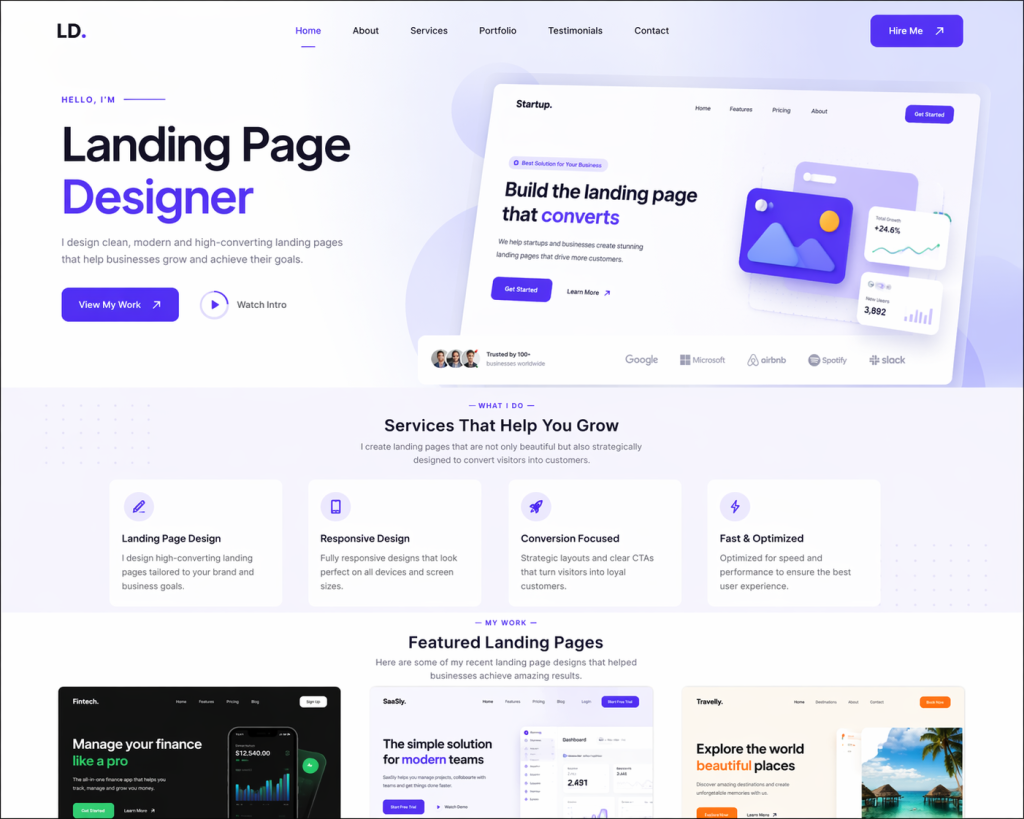
A landing page design template
Title
It goes without saying, but the title of your landing page needs to grab the attention of the reader – it’s possibly the only thing they’ll read. If you get it right, it could be the first thing they read before ultimately making a purchase!
Your title needs to be set in a large, easy to read font – it should be the largest text on the page.
The copy of your title is critical and ties back to what we were covering earlier in the “defining your value proposition” section.
Subheading
If the visitor reads your title, then perhaps they’ll consider reading your sub heading too – it’s the second most important piece of copy on your page.
Your subheading should build on the title to clarify the attention-grabbing headline to tee up the visitor to want to learn more and ultimately click your call-to-action button.
Social proof
If you have customers, you can build social proof.
If you are fortunate enough to have already won a well-known customer or two, get their logos on your page as fast as you can.
It’s incredible how often this key element of a landing page is forgotten in the race to get a page live. Social proof takes time and effort to gather, but the result is dramatically increased credibility, and an ability to handle objections from visitors without having to speak for yourself.
Just let your customers do the talking.
Good questions to ask existing customers include:
- What were your concerns when you first signed up for our product and how did you overcome them?
- Why did you pick our product over the competition?
- How would you describe your product to a friend?
These questions will hopefully lead to some powerful quotes that you can add to your landing page to effectively address any common concerns of visitors before they hit the “back” button.
Call-to-action
We recently wrote the ultimate guide to writing and designing effective call-to-action buttons (CTAs) – it’s been read by thousands of people and shared all around the world by some of the most influential designers and marketers out there.
If you’re keen to learn more about call-to-action buttons and want to see a healthy selection of examples, then we highly recommend you check out that guide.
Features or solutions
Chances are you’re closely connected to your product or service – you know every bell and every whistle you have to offer.
But when it comes to creating an effective landing page, you need to step away from some of the details – you need to focus less on “what” your product does, and more on “why” it matters to the people viewing your page.
For example, here at GoSquared, it’s great that we have so many features in our live chat product –and that it’s beautiful and easy-to-use.
But most people outside our team don’t really care about these details.
Most people care about how GoSquared can make them more money, how we can help their team be more productive, and how we can deliver measurable improvement to their conversion rates.
As an exercise for your own product – try to describe why it’s helpful to someone without specifically calling out any features. Focus on the “why” and you’ll go a long way to writing more persuasive copy for your page.
Call-to-action (again!)
Repeating your call-to-action rarely hurts. What you see as the creator of your landing page is very different to what a visitor will see. Remember that you only have seconds to grab the attention of a visitor, and to encourage them to consider your product or service.
Repeating a call-to-action can sometimes feel, well, repetitive when you are creating a page or any kind of website. But remembering that visitors may be jumping around and spending mere seconds, will likely make you feel more comfortable repeating your call-to-action at least once to ensure the visitor is never far away from taking their next step.
Footer
The footer of your landing page is valuable real estate. If someone makes it all the way through your landing page, they’ll end up bumping into your footer and potentially rest there for a few moments.
Given your landing page is focused on encouraging the reader to take a specific action, you want to try to avoid distracting the visitor with links and copy that could alienate them.
For instance, many larger websites have a huge number of pages and have a form of site map in their global footer. For your landing page you want to avoid putting any unnecessary links in the footer that could take a visitor on an unintended path.
Your footer, though, is an opportunity to add further reassurance for visitors – for example:
- Add the date of when your business was founded to reassure people you are here to stay.
- Show a “total customers” count to remind visitors they’re not the first to ever buy from you.
- Show a star rating from a review site to add credibility.
- Especially if you’re making a physical product, show where your product is designed or made.
Why Businesses Need Landing Page Designers
Why not just use a normal webpage?
Because normal pages distract. Landing pages focus.
A good designer ensures:
- Clear messaging
- Strong visuals
- Persuasive flow
Importance of Landing Pages in Digital Marketing
First Impression Matters
You never get a second chance to make a first impression.
Landing pages are often the first thing users see after clicking an ad. If it’s messy or confusing, they bounce. Simple as that.
Conversion-Focused Design
Unlike blogs or homepages, landing pages are laser-focused. Every element—from the headline to the button—has one purpose: to convert.
Key Skills of a Landing Page Designer
UX/UI Design Knowledge
Design isn’t just about looking pretty. It’s about usability.
A good landing page designer understands:
- User behavior
- Layout psychology
- Color impact
Copywriting Skills
Design alone won’t sell.
Words matter. A lot.
Great designers know how to write:
- Catchy headlines
- Persuasive CTAs
- Benefit-driven content
Technical Skills
HTML, CSS, and Tools
You don’t need to be a hardcore developer, but understanding the basics helps.
Most designers use tools like:
- Page builders
- CMS platforms
- Drag-and-drop editors
Essential Elements of a High-Converting Landing Page
Headline and Subheadline
Your headline is your hook.
If it doesn’t grab attention in 3 seconds, you’ve already lost the visitor.
Call-to-Action (CTA)
This is where the magic happens.
“Buy Now,” “Get Started,” “Download Free Guide”—your CTA should be clear, bold, and irresistible.
Visual Content
Images and videos can boost conversions massively.
But here’s the trick: they must support your message—not distract from it.
Social Proof
People trust people.
Testimonials, reviews, and case studies build credibility and reduce hesitation.
Types of Landing Pages
Lead Generation Pages
These collect user information like email addresses in exchange for something valuable.
Click-Through Pages
These warm up users before sending them to a sales page.
Sales Pages
Designed to directly sell a product or service. These are often longer and more detailed.
Landing Page Design Process
Research and Planning
Before designing anything, you need to understand:
- Target audience
- Goals
- Competitors
Skipping this step is like building a house without a blueprint.
Wireframing
Think of this as the skeleton of your page.
It outlines:
- Layout
- Content placement
- User flow
Design and Development
Now comes the creative part—bringing everything to life with colors, fonts, and visuals.
Testing and Optimization
No landing page is perfect on the first try.
Designers run A/B tests to see what works better—headline A or headline B?
Best Tools for Landing Page Designers
Design Tools
Popular tools include:
- Figma
- Adobe XD
- Sketch
These help create stunning layouts and prototypes.
Builders and Platforms
For building actual pages:
- WordPress + Elementor
- Webflow
- Unbounce
These tools make designing faster and more efficient.
Common Mistakes to Avoid
Too Much Information
Less is more.
Overloading your page confuses users and kills conversions.
Weak CTA
If your CTA is boring, people won’t click.
Simple rule: Make it action-driven and benefit-focused.
Slow Loading Speed
Speed matters.
Even a 1-second delay can reduce conversions significantly.
SEO Tips for Landing Pages
Keyword Optimization
Use your main keyword naturally throughout the page:
- Headline
- Subheadings
- Content
Mobile Responsiveness
Most users are on mobile.
If your page doesn’t look good on a phone, you’re losing traffic.
Page Speed
Optimize images, use fast hosting, and minimize scripts.
Fast pages = better rankings + higher conversions.
Future Trends in Landing Page Design
AI and Personalization
Imagine landing pages that change based on who’s visiting.
That’s not the future—it’s already happening.
Interactive Elements
Quizzes, animations, and micro-interactions are becoming popular because they keep users engaged.
Conclusion
Landing page design isn’t just about making things look nice—it’s about creating experiences that convert.
A skilled landing page designer combines psychology, design, and marketing into one powerful tool. Whether you’re a business owner or a developer, mastering landing pages can dramatically boost your results.
So next time you land on a page, ask yourself: Would I convert?
If the answer is yes, now you know why.
FAQs
1. What does a landing page designer do?
A landing page designer creates pages focused on converting visitors into leads or customers using design, content, and strategy.
2. How is a landing page different from a website?
A landing page has one goal (conversion), while a website has multiple pages and purposes.
3. What tools do landing page designers use?
Common tools include Figma, Elementor, Webflow, and Unbounce.
4. How long should a landing page be?
It depends on the offer. Simple offers need short pages, while complex products may require longer ones.